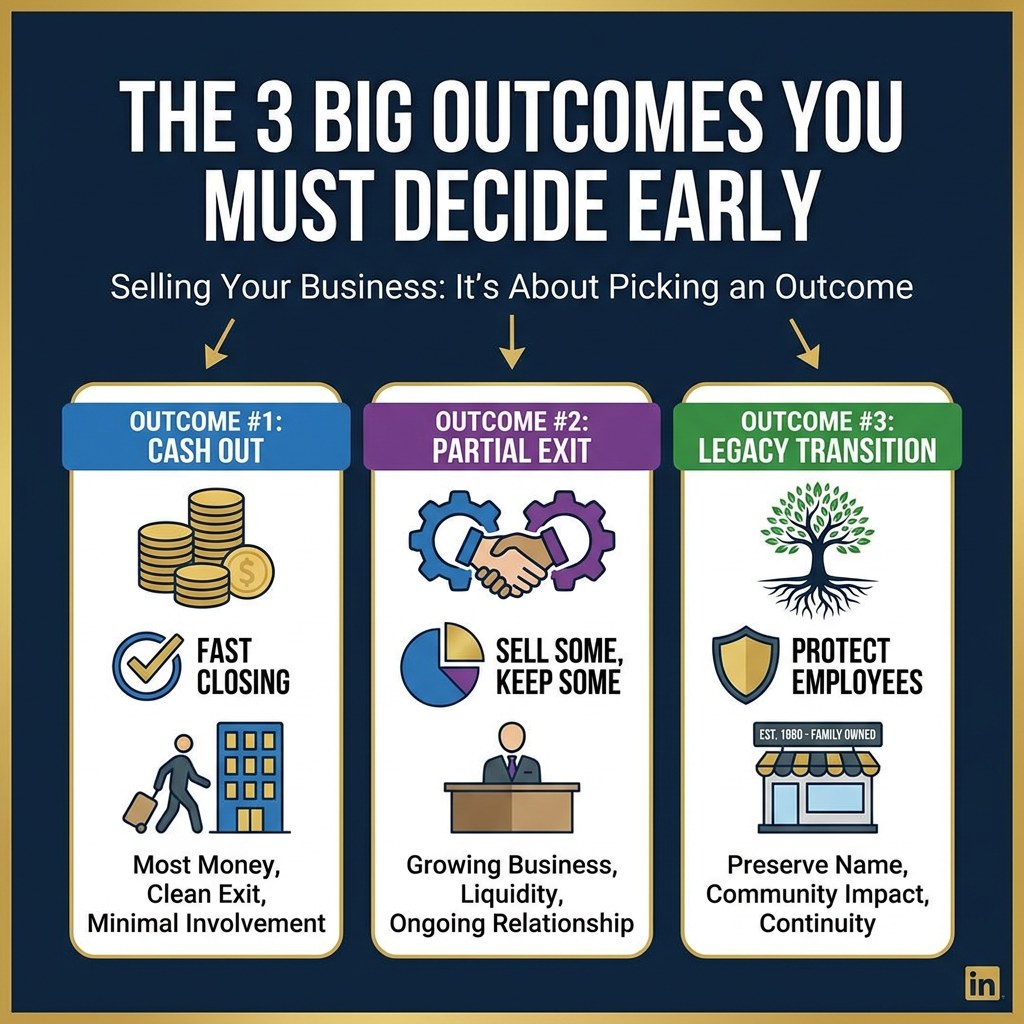
In short: There are three main ways to exit a business: a full cash-out sale, a partial exit where you sell some equity and keep some, and a legacy transition that prioritizes employees, the company name, and continuity. Choosing your outcome early shapes how you prepare, which buyers you target, and how the deal is structured.
Most people think selling a business is about picking a buyer. Actually, it's about picking an outcome.
The three most common outcomes are:
Cash Out
You want:
- The most money
- The cleanest exit
- The fastest closing
- Minimal involvement afterward
This is the dream scenario, but it requires the highest level of preparation, because buyers will only pay “cash out money” for low-risk businesses.
Partial Exit
You sell some equity, keep some. This works well when:
- The business is growing
- You still enjoy part of it
- You want liquidity but not full retirement
- The buyer wants you to stay involved
This can be a great wealth-building move, but it also means you're still in a relationship with the buyer.
However, this business relationship can be a lot like dating: Exciting in the beginning… complicated later.
Legacy Transition
You want:
- To protect employees
- To preserve the business name
- To prioritize community impact
- To ensure continuity
- To exit in a way you feel proud of
Often seen with:
- Family businesses
- Local service companies
- Restaurants
- Mission-driven companies
Legacy transitions can still be profitable, but the “best buyer” isn't always the highest bidder.
Go deeper: See how deal terms shape your outcome when you sell your business.
How to choose your outcome
Start with what you want your life to look like after the deal — see what the exit actually looks like — then ask yourself:
- How much money do you need, and when?
- How long are you willing to stay involved after closing?
- How important are your employees, your company name, and your community?
- Do you believe in the business’s future growth enough to keep a stake?
Common questions
What are the different ways to exit a business?
The three most common are a full cash-out sale, a partial exit (selling some equity and keeping some), and a legacy transition that prioritizes employees, the company name, and continuity.
What is a partial exit?
A partial exit means selling a portion of your company’s equity while keeping a stake. You get liquidity now, usually stay involved, and can benefit if the business keeps growing.
What is a legacy transition?
A legacy transition puts continuity first — protecting employees, preserving the business name, and serving the community. The best buyer isn’t always the highest bidder.
Which exit option gets the most money?
A full cash-out can bring the most money at closing, but buyers only pay top dollar for low-risk, well-prepared businesses. A partial exit can create more total value over time if the business keeps growing.